How to Read and Compare Roofing Estimates
October 27, 2026 · Sure Claim Roofing LLC
Need a Roof Inspection?
Free, no-obligation. 7 days a week in Baytown and East Texas.
Book Free Inspection(281) 691-0552You have two roof replacement quotes on the table. Both mention architectural shingles. One has a long list of roofing terms; the other gives you a short description and a total. How do you tell whether the difference is fair pricing, different work, or something you should question?
Compare the roof being measured, the materials and work included, the rules for unexpected damage, and the written warranty before comparing the totals. A longer estimate is not automatically better, and the lower quote is not automatically missing work. Your goal is to turn important unknowns into written answers.
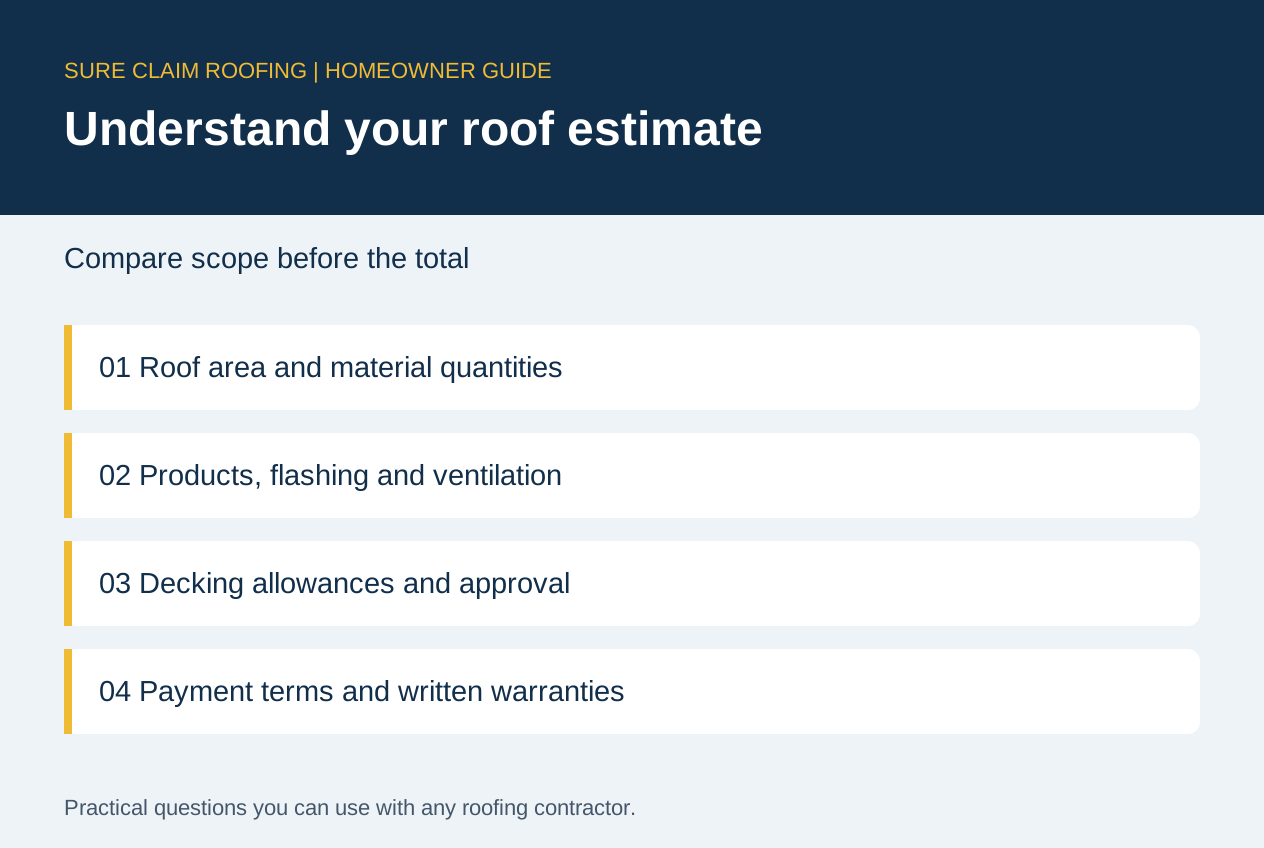
This guide walks through actual roofing-estimate terminology, an annotated teaching example and a side-by-side comparison. Use it with any contractor, even if SureClaim is not on your shortlist.
1. Start with the scope, not the bottom line
Read the document heading and signature section first. Is this a preliminary estimate, a fixed proposal with conditions, a repair authorization, or a contract? What does your signature authorize? Does the price expire, depend on inspection, or allow substitutions? Ask before signing if that is unclear.
Then identify the work boundary. Does the quote cover the house, attached garage, porch and detached building, or only some slopes? A low-slope porch may need a different roof system from the main shingle roof. Ask for a roof diagram or labeled photographs so each contractor is discussing the same areas.
This is not just theoretical paperwork. A publicly available contractor proposal reviewed for this guide specifies one existing layer for removal, identifies products and possible substitutions, and lists plywood and other woodwork separately from the main scope. Those conditions matter even when the headline description sounds complete. Public contractor proposal, August 2025, page 3
2. Decode SQ, SF, LF, EA and bundles
Roofers price different parts of a roof in different units. You do not need to measure the roof yourself to ask how those quantities were obtained.
Scroll sideways to compare every column.
| Estimate abbreviation | Plain-language meaning | What to check |
|---|---|---|
| SQ or square | 100 square feet of roof surface | Is this measured roof area or ordered material including waste? |
| SF | Square feet | Which surface or material does the area describe? |
| LF | Linear feet, a length | Which roof edges, ridges, valleys or wall junctions were measured? |
| EA | Each item | How many vents, pipe flashings or other individual items are included? |
| Bundle | A package of shingles | What coverage does this exact product provide, and are starter and caps separate? |
| Sheet | A panel of roof decking | What dimensions, thickness, material and installed rate apply? |
One roofing square means 100 square feet, not the floor area of the house. Roof slopes and overhangs affect the surface being covered. GAF, November 2021
Do not assume every shingle takes the same number of bundles per square. Check the exact product's package coverage. Manufacturer estimating guidance also distinguishes field shingles from starter, hip and ridge materials. IKO, April 2025
Why does the new-shingle quantity exceed the tear-off quantity?
That can reflect cutting waste rather than an inflated roof measurement. GAF's published sample shows 17.60 SQ removed and 19.36 SQ of replacement shingles, with a note explicitly identifying 10% waste. That is one example, not a recommended allowance for every roof. GAF sample estimate, October 2023
Ask: “What is the measured roof area before waste, what allowance did you use, and why does it fit this roof?” If one contractor calls the ordered quantity the roof size and another gives the measured area, comparing those numbers directly can create a false disagreement. A material report can distinguish roof areas, edge lengths and waste scenarios. GAF sample measurement report, April 2025
3. Walk through an estimate with the important questions marked
Annotated teaching example
Read these lines before comparing the total
Fictional scope excerpt. Quantities illustrate the questions to ask. This is not a SureClaim quote or a price recommendation.
Remove existing shingles
20 SQ; one existing layer
What to check: Ask which roof sections and how many layers this covers. Another layer can change removal and disposal work.
Architectural shingles
22 SQ; product not named
What to check: Extra quantity may be cutting waste. Confirm the measured roof area, waste basis and exact manufacturer/product/color.
Underlayment and accessories
Included; details not listed
What to check: Included is useful only when defined. Ask for product types, locations, starter/caps and flashing scope in writing.
Replace damaged decking
As needed; rate not stated
What to check: Resolve before signing: included allowance, installed unit rate, sheet specification, photo evidence and approval process.
Workmanship warranty
Warranty included
What to check: Ask for the actual terms, duration, responsible company, exclusions and how to request a return visit.
Notice what the example does not tell you. “Architectural shingles” does not identify the exact product. “Accessories included” does not say which accessories. “Wood as needed” leaves both the charge and the approval process unresolved. None of those phrases establishes fraud. They establish work you still need to clarify.
4. Understand the line items that change the actual job
Removal, disposal and access
“Tear-off” means removing existing roofing. Ask how many layers are included, which areas will be opened, what happens to debris, and whether disposal is already included elsewhere. A separate dumpster line is not automatically a duplicate. Equally, a removal line does not automatically include every disposal cost.
Height, steepness and difficult access can change the work plan. If a charge sounds unfamiliar, ask the contractor to identify the affected section and explain what the charge covers. Do not climb the roof to check it yourself. Keep the explanation with the proposal.
Field shingles, starter and hip/ridge caps
Field shingles cover the main roof planes. Starter material serves the roof edges; hip and ridge caps cover the intersections at the roof's raised lines. Ask for the intended products rather than assuming one shingle description names the entire system. GAF's estimating legend separates these categories and also shows why a shingle line described as “without felt” does not include underlayment in that particular line. GAF estimating legend, undated
For appearance, keep the approved product and color in writing. Our shingle-color comparison guide shows how to check the choice against brick, siding and trim before ordering.
Underlayment and leak barriers
Underlayment is a layer beneath the shingles. A proposal may identify felt or synthetic underlayment and a separate self-adhered barrier at specified locations. Ask which products go where and why. Different roofs and product instructions can require different assemblies. A premium-sounding label alone does not explain the proposed installation.
If one quote lists several layers, ask whether they cover different locations or overlap in a specified detail. The useful answer is a location and installation explanation, not simply “better protection.”
Flashing and pipe boots
Flashing directs water at roof interruptions such as walls, chimneys and pipes. A pipe boot is the flashing assembly around a pipe that comes through the roof. Ask which pieces will be replaced, retained or evaluated during removal, and what opening the surrounding materials involves.
Existing flashing is not automatically unsuitable, and “all new flashing” is not sufficiently precise by itself. GAF recommends replacement when possible but allows certain like-new metal flashings to remain under stated conditions. Have the contractor explain suitability, compatibility and any warranty requirements for your proposed system. GAF technical bulletin R-170, February 2021
Ventilation, roof edges and completion work
Intake lets outside air enter the attic ventilation path; exhaust lets air leave. Ask whether ventilation work means replacing existing components or changing the arrangement. What intake and exhaust conditions support that recommendation? What happens to unused openings? “Add ridge vent” alone does not explain the whole ventilation plan.
Also clarify edge metal, the metal trim at the roof perimeter, protection of landscaping and patio covers, debris removal, nail cleanup and the final walkthrough. Manufacturer homeowner guidance recommends putting products, accessories, cleanup, dates and payment terms in the agreement. IKO installation guide, undated
5. Settle the hidden-wood question before tear-off
Decking is the layer of boards or panels attached over the roof framing, beneath the roofing layers. Its full condition may become visible only after removal. You can agree on how discoveries will be handled before anyone opens the roof.
Ask for these points in writing:
- Included allowance: How much decking replacement, if any, is included in the quoted total?
- Unit and specification: What counts as one sheet or another charging unit? What material and thickness apply?
- Installed rate: Does the extra-work rate include removal, material, labor, fasteners and disposal, or are some separate?
- Evidence: Will you receive photos and the location and quantity of affected material?
- Approval: Who contacts you, how do you approve the change, and how is that approval retained?
- Different work: How will framing, fascia or other damage outside the decking scope be assessed and quoted?
Imagine two sheets are included and five need replacement. Ask the contractor to show how the three additional sheets would be charged using the agreed rate. This is a teaching scenario, not a prediction about your roof. Ask what happens if you are unavailable and how temporary weather protection will be handled while a decision is pending.
“There might be wood damage” can be an honest limitation. “We will decide the price afterward” leaves you without the information needed to make a decision.
6. Put the proposals side by side
Scroll sideways to compare every column.
| Compare this | Proposal A says | Proposal B says | Your next question |
|---|---|---|---|
| Roof area and waste | 20 SQ measured; 22 SQ shingles | 22 SQ roof; waste not described | Is 22 SQ measured area or material quantity? Show the same roof sections on both measurements. |
| Decking | Two sheets included; installed rate stated for more | Wood replacement extra | What is included, what is the installed rate, and who approves additional sheets? |
| Flashing | New pipe boots; existing wall flashing evaluated for reuse | All new flashing | Which specific locations, what access is included, and how is retained flashing judged suitable? |
| Ventilation | Replace ridge vent; inspect intake | Add ridge vent | Does the scope explain existing intake, exhaust and any alterations needed for this roof? |
| Warranty | Written workmanship terms attached | Lifetime warranty | Whose warranty, what part of the work, which exclusions and what registration requirements? |
The table does not declare a winner. Proposal A has clearer answers in some areas; Proposal B might explain its differences once asked. For example, genuinely broader flashing work could justify additional work and cost. An unnecessary upgrade should still have a reason tied to your roof.
Use the printable roof-estimate comparison worksheet to record each quote's scope, exceptions, change rules and follow-up questions. Leave unknowns marked “not confirmed” rather than filling them with assumptions.
7. Question suspicious-looking charges without jumping to conclusions
- “Why am I paying for both removal and installation?” They describe different work. Ask whether the quote combines them elsewhere before alleging duplication.
- “Why are there material and labor summaries after the line items?” A recap can restate the same cost. Ask which section establishes the payable total; do not add every repeated summary together.
- “Why does one bid bundle everything?” A bundled price can be useful when the included scope and exceptions are defined. Separate prices for every accessory are not the only acceptable format.
- “Why is the price much lower?” Compare scope, product, allowances, payment terms and warranty first. Price alone cannot establish either value or corner-cutting.
- “Why does the quote promise a lifetime roof?” Request the actual warranty and identify what “lifetime” means under its terms, including exclusions and who responds to a problem.
- “Why do they need my signature just to inspect?” Read the document's obligations. A document presented as an estimate may authorize more than you intended. Stop and clarify before signing.
If you still suspect a duplicate or unexplained charge: Ask the roofer to reconcile the operation, location, quantity, unit rate and included work. Request a corrected or clarified proposal rather than relying on a verbal reassurance. If a material discrepancy remains unresolved, pause before authorizing that work and seek an independent assessment.
Texas consumer guidance specifically warns against blanks, rushed signatures and agreements that tie payment vaguely to insurance proceeds. Keep the written proposal and every agreed change. TDI contractor guidance, December 2025
For Baytown properties, permit responsibility depends on the work. The city's checklist distinguishes shingle-only replacement from roof-deck installation, replacement or repair. Confirm your actual scope with Building Services; a different city or unincorporated address may follow a different process. City of Baytown, undated, checked October 2026
8. Check warranties, payment and insurance separately
Ask which warranty covers the product, which covers workmanship, who provides each, and who completes any registration. Some enhanced manufacturer warranties also cover workmanship under their terms. Read the documents rather than comparing the largest year-count in the sales pitch. Ask what you keep after completion and whom you contact first. CertainTeed contractor-selection brochure, undated
Confirm the total contract amount, payment milestones, exclusions and how approved additions alter that amount. A contractor proposal and an insurer's estimate are different documents. Ask your insurer about coverage and policy calculations; a construction quote cannot establish what your policy will pay. Texas also prohibits contractor deductible waivers and contractors acting as public adjusters on property where they provide or may provide contracting services. TDI, March 2025
Send this clarification request to each roofer
“Before I compare the totals, please confirm the measured roof area before waste, the roof sections and layers included, exact shingle and accessory products, flashing and ventilation work, decking allowance and installed additional-work rate, approval process, exclusions, permit responsibility, payment milestones and the warranty documents. Please add the answers to the proposal so we are working from the same scope.”
Once the important differences are understood, use our roofing-company comparison guide to check the people responsible for delivering the work. If you want another assessment from SureClaim, you can request an inspection. Keep using the same questions whichever company you choose.
Sources
- GAF sample estimate, October 2023.
- Actual public contractor proposal, August 2025, page 3.
- GAF: Roofing squares, November 2021.
- IKO: Estimating a roofing job, April 2025.
- GAF sample measurement report, April 2025.
- GAF estimating legend, undated.
- GAF flashing bulletin R-170, February 2021.
- IKO installation guide, undated.
- TDI contractor guidance, December 2025.
- City of Baytown permit checklist, undated.
- CertainTeed contractor-selection brochure, undated.
- TDI roofing and insurance guidance, March 2025.
Sure Claim Roofing LLC
Baytown, Texas
Roofing information for homeowners in Baytown and surrounding communities. Contact our team for an assessment of your property.
Need a Free Roof Inspection?
Book Your Free InspectionSee What Your Roof Should Cost in About a Minute
Type your address, and we measure your roof from satellite imagery and show you a real price range. Know your number before you talk to your insurance company.
Free. No obligation. Your price appears instantly online.
See your roof price in 60 seconds
Type your address. We measure your roof from satellite imagery and show you a real price range. Free, and no salesman visit required.
Prefer to talk to a person? Book a free inspection